Thursday, July 17, 2014

Shooting Uncle Otto

In the 1960s, Uncle Otto (“Z- Da-do” in our Neapolitan slang) ran the candy store on President Street below Third Avenue. Candy was stale and cigarettes cheap, smuggled tax-free from North Carolina. I was fifteen, a Catholic school boy studying Latin and thinking about girls and college. My friends and I, useful dolts, played cards in Otto’s back room—usually gin rummy or the Italian briscola—while Otto kept track of the numbers runners and gamblers—my godfather, “Blubber Head,” among them—who hurried in and out.
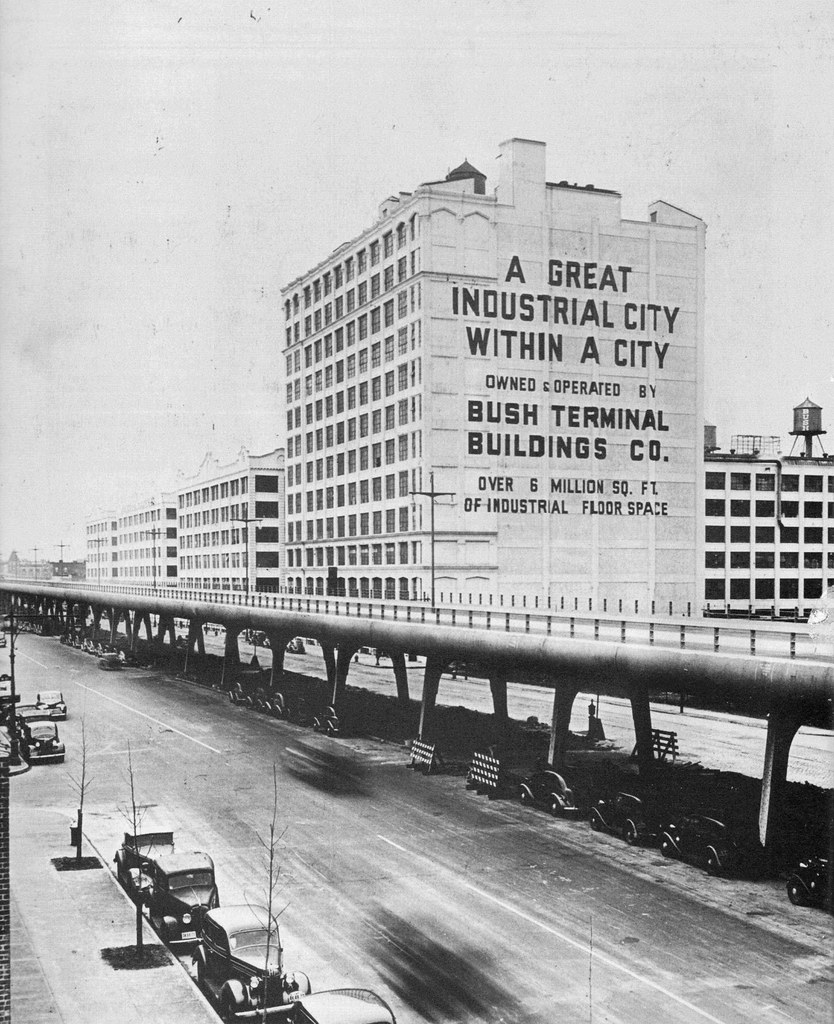
Bookie parlors were the fast food joints of the neighborhood. There were four in a three block radius—Otto’s, the Capri and Glory Social clubs on Third and Carroll (run by “The Goose,”) and a very dangerous one on Fifth Avenue off Carroll Street. "Runners" had different territories. "Jimmy the Morgue" covered his place of employment, the Kings County morgue in Bed-Sty. And of course, everyone knew he had sex with corpses. "Fat Rosie" collected bets from Puerto Rican workers in the factories at Bush Terminal'," a manufacturing complex on 3rd Avenue near the Brooklyn piers.(A gigantic "Industrial City" billboard was painted on the first building, a primitive version of Star Wars' famous scroll. At age 7, I'd try to read it all the way down on the Tuesday evenings my father drove his '56 Caddy along the Gowanus Parkway to Coney Island for Nathan's hot dogs, fries, orangeade and fireworks. Never could finish. See image below.)
On weekends, football games, Belmont and Aqueduct races blared on Otto’s TV. Desperate, soon-to-be fearful gamblers shouted and cursed in English and Italian. We were kids. We’d order hero sandwiches stuffed with ham, Genoa salami, provolone, tomatoes, olive oil and hot peppers on bread still warm from Gallo’s bakery. We avoided my cousin, Mariuchella, who skimped, in favor of my aunt Lucy Giovanucci. Lucy had a whacky sense of humor: she berated her regular customers as “whores, cocksuckers and fuck-faces” as she filled their orders. They loved it. She drove a pink ’56 Cadillac and was the kindest person I knew. Like my parents, she'd endure a lifetime of tragedy.
Otto dressed in a suit every day, well-cut, muted blue or brown. He wore glasses, a white shirt and tie, and never spoke above a whisper, on or off the phone. He might have been an insurance agent. One Saturday, half-a-dozen FBI agents came charging into the candy store. Otto wasn’t around and the feds, to their chagrin, found themselves rousting four teenagers eating meatball sandwiches. ("Who sold you that beer?")They pushed us around. Looked here and there, left.
A day came when a guy I didn’t recognize walked into the store, maybe from Court Street or Bensonhurst. He and Uncle Otto talked. Otto looked at us for a moment, nodded toward the front door and walked outside. The guy seemed nervous; Otto phlegmatic. The conversation ended when he pulled out a revolver and shot Otto apologetically in the chest. Otto’s glasses flew across the pavement. I saw the red smear of blood slowly spreading across the front of his white shirt. There was no coup de grace. The guy fired once and walked away. He had an unpleasant job to do and had done it. Message delivered.
Another time, I was standing outside the club, when three or four of the worst neighborhood punks—my cousin “Popeye Anthony,” among them, ran frantically up President Street. They’d been chased across the canal by 50 furious blacks who streamed out of the Gowanus House projects on Bond and Wyckoff Streets—the same buildings described a generation later by Jonathan Lethem.
One of the kids was holding a rifle. He ran by, stopped and saw me silhouetted against Otto’s picture window.  He raised the gun. I was five feet away. It took forever. An older man ran up and slapped the gun out of the kid’s hand.  For the next hour, the wise guys heard the honest grievances of the black men. This was a time when whistling fireworks were labeled "ni__er-chasers," and the occasional African-American corpse floated down the Canal like something out of Huckleberry Finn.
The talk was like a powwow in a Western. I saw things that way. Years later, when I was working  for Newsweek, I used to visit the “morgue,” where thousands of yellowing newspaper clips were stored. I’d read gangster stories to see whom I knew or recognized from the “old neighborhood.”  One story caught my eye.  The remains of four murder victims—maimed and tortured—were being removed from the cellar of Uncle Otto’s candy store.
Way back when the Feds had arrived, knowing too little, too late.

Friday, April 18, 2014

Good Friday on the Gowanus

The nuns advised us that on Good Friday all activities--stoop ball, stick ball, Kings, head-slapping, car-fender sitting, etc.--had to stop between the hours of noon and 3 pm the time Jesus spent on the cross. And we did faithfully, except for the one time Augie Aversano, an actual devout Catholic was granted his deepest desire, we tied him--rope rather than nails--to the wrought iron fence outside Our Lady of Peace Church and left him, as they say, hanging.

Monday, November 4, 2013

Election Night: A Bonfire of the Vanities


Halloween over, we raced to the next great ritual, the Election Day bonfire. At 14, I don’t think I knew the name of the president of the United States. It didn’t come up much. Not until Kennedy ran and the Irish bishops and parish nuns were in a dither getting out the vote. I knew the mayor—a crumbling pie factory on Fourth Avenue, bore his name—Wagner. We’d buy damaged pies for a nickel and smash them, sticky lemon and pineapple, in each other’s faces. To me, the governor’s name, Rockefeller, was so alien it might have been a petroglyph.  Across the East River, Manhattan glimmered, unreachable, insubstantial.  
Built over Carroll Street’s ancient cobblestones the bonfire was a tradition that predated the black-clad women simmering tomato sauce on Sunday mornings or i pazzi, the crazy people, wandering our streets. Unlike so much in our circumscribed world, it had very American feel to it, Bull Moose Party…Boss Tweed…Salem’s incandescent witches. We raided Chitty’s fruit and vegetable store for orange crates and wooden bushel baskets, then Cambie’s Trucking, pulling splintery wooden pallets from the bays of tractor trailers. We went door-to-door demanding fragrant wine barrels. cracked linoleum and unwanted furniture. As the frenzy built, we’d literally pull wooden cellar doors off their hinges

Jerry Lang, Honey Christiano and Jackie Carr, abetted us, winking as we dragged busted folding chairs and card tables from the Glory Social and Capri Club on Third Avenue. The wise guys were, in all things, irresponsible: perfect negative role models. We were lost boys bucking against all societal restraints. In the decades ahead, we’d die of cancer and birth defects even if we’d escaped to the ranch houses and stick-tree suburbs of Long Island and New Jersey. We’d die of  other plagues—violence, AIDS, abandonment and addiction—visited on South Brooklyn.

I lived outside the United States. No one gave a fuck about voting. Every election my father would announce—as if he’d unearthed a kernel of infinite wisdom—“No matter who wins, I still gotta go to work in the morning.”
We competed against kids from President and Union Streets, and the alien territories across the Gowanus, for the biggest, most out-of-control blaze we could manage. Preempting us, the Fire Department, sent raiding parties to haul away our hidden stores of planks and beams. We met them with barrages of eggs and rotten fruit, letting fly as we darted in and out of the empty lots across from Monte’s Venetian Room
If they caught you, firefighters, burly Irishmen from Bay Ridge and Flatbush, would beat the shit of you. The same gangsters cheered them on. But they couldn’t be everywhere. At dusk on Election Night, we emerged like crazed rats from hallways, cellars and alleys, lugging wood, stacks of newspapers and plastic gallons of gas, turpentine, paint. Darting, whirling, teenaged Maxes from Where the Wild Things Are. My buddy, Americo Guzzi, hammered the outsized brass nut on the fire hydrant, deforming and disabling it. Skinny kids, Joe Bo and Philly Horse Teeth, scrambled like beetles up the pile, now three stories high and 40 feet across No one, not even the adults, seemed to register that almost all the houses on Carroll Street were made of wood,sheathed in tarpaper and flammable shingles.
By 9:00 P.M., alarms were sounding everywhere. Sirens blared, fire trucks careened around corners. On the fire escapes younger kids readied volleys of eggs. Honey, 46-years-old and just out of prison, tossed a wooden torch—wrapped with rags soaked in gasoline—onto the pile. In seconds, it exploded, turning night into day. I was too close. I felt the combustion’s blast. A wave of intense heat sucked the air out of my lungs.
“Holy shit!”
 I ducked behind a parked car, half-blinded by smoke, gasping, grinning, watching Jeannie Wilcox, Amy Gallo, my cousin Clementine, a handful of other cute girls in pink lipstick, leather jackets, tight jeans, as they stood transfixed. The heat washed over them, sensual. I could see that. They ignored me.
The flames were so high all the telephone wires on the street were melting and burning. Embers were floating delicately over tar paper roofs. We’d showed those other street punks.
“Where the fuck is the Fire Department?”  Someone roared, the spell broken.
When they arrived, the “Johnny pump” was broken. There was no water pressure in the pipes. To impress Jean I stood up, let fly with my last egg.
“Fuck you guys!”
“Grab that little cocksucker!”
 I ducked and ran into the alley next to Honey’s house, a big guy in a yellow rubber suit closing fast. Convinced I could dodge him, I cut, slipped, and rammed my head into a cinderblock wall.

Wednesday, October 30, 2013

Halloween On The Gowanus


Halloween On the Gowanus
The RKO Prospect Theater was hosting a live Halloween Show, staffed no doubt by rheumy alcoholic ushers dressed like Dracula. I’d seen them stringing spider webs over the orchestra seats. Or maybe my grandfather’s tenant, Mrs. Mahoney, who lived in a tiny stanzina and cursed God aloud on Sunday mornings.
I was 16, tall, lanky, with a big head. Joe, my father, was 40, shorter, but built like Sam Huff the result of decades unloading Black Diamond Line ships in Red Hook.
Enraged, Joe was worse than Frankenstein. Even the Goose and the other wise guys standing outside the Capri Club on Third Avenue were wary of him.
“No,” my father said. “You can’t go.”
 “Dad!”
“Are you deaf?”
Savages roamed Fifth Ave., terra incognita in our mafia-controlled neighborhood: Golden Guineas, Bishops, Gents, Apaches, stoned on airplane glue and Tuinal, all making for the Prospect, their tight pants, white-lipsticked girls strutting alongside them. A week before, my cousin JuJu had hurled a fire axe during a screening of Them at the Garfield Theater. It whirled over my head piercing one of the outsized ants rampaging across the screen.
Halloween was stink bombs, chalk stockings, rotten eggs, cherry bombs, Tango screwdrivers and Twister wine.
“Can I at least go trick or treating?”
“Joe, let him go for an hour,” Gloria intervened.
“He’s got homework,”
“Ma!”
“You better be home by 10 o’clock.”
I was out the door, down the stairs, one of Joe’s sweat socks stuffed in my flannel shirt pocket, two thick cylinders of colored chalk and two eggs I’d hidden the hallway.
There were no treats in South Brooklyn. No cute ballerinas, pink Cinderellas, no Supermen in sagging tights. The hipsters who'd pollute the Gowanus with 'tude and snap brim fedoras were 40 years distant. Tricks were payback: rotten eggs smashed against the windows of the rectory and convent--Masseo, the friar in charge of the altar boys in Our Lady of Peace parish was a pervert, molesting boys behind his robes; Malachy, a Franciscan, her face the color of corned beef, her wimple wide as a sail, tormented and humiliated me; spray paint on Mariuchelle’s storefront window for the greasy meat and stale bread she served.;stink bombs in subway token booths; cherry bombs if we could catch cops from the 76th  Precinct—who worked hand-in-hand with gangsters—cooping in the lot across from Monte’s Venetian Room.
Halloween was war. A gang from Bond Street took my cousin Anthony Popeye prisoner one year, tied him to a rotting beam and hung him, screaming, over the Gowanus Canal. We couldn’t get near him for hours. The scene reminded me of the sketch of Iroquois torturing Jesuits I found in my Catechism.
My guys were waiting. Using a brick, I pounded the chalk inside the sweat sock, more gravel than powder. I tried it out on a new car, Fat Rosie’s awning, Frankie Cag’s head.  A sun-yellow cloud puffed in the air.
“Fuck it! Let’s go!”
Howling, we ran—a dozen of us—down President Street, socks whirling over our heads. We cornered five guys in front of Otto’s Social Club—Peter Lauro, Anthony Fisheye, Crazy Ralph, Louie the Fag, as I recall, and beat them mercilessly with our stockings. Wise guys dropped their gin rummy hands, came pouring out, and ducked back inside. We were wilding, a thing they understood.
Our prisoners, rubbing lumpy noses, and swollen eyes were handed chalk stockings. A punk who always got good grades, I felt the blood singing in my veins. We attacked Union Street, Sackett Street and the Puerto Ricans junkies nodding in the shadows of Degraw Street Park, a very dangerous place. All fell before us.
In a hour, I had dozens of ragged teens running beside me, pulling fire alarms, spilling trash cans, breaking off car antennas, smashing pumpkins, terrorizing the sissy boys coming out of the Prospect Theater’s fucked-up Halloween show, a ribbon of screaming cop cars trailing behind us.
And then it was 10:00 P.M. Like Cinderella, I had to go home.


Thursday, January 31, 2013

My Father, Myself
 Haloed in darkness, Joe appears in the doorway, rugged, wind-burned face impossibly handsome, watch cap and olive drab fatigue jacket stiff from the Red Hook piers’ icy spray. My brothers and I surge forward, press our cheeks against our father’s, his cold passing into our little boy warmth. I remove the wooden- handled longshoreman’s hooks slung over his shoulder, a squire receiving his knight’s sword.
There were days when he’d unzip that jacket and dozens of tinseled chocolate Easter eggs would cascade to the cracked linoleum floor…Dutch van Houten orange chocolate bars rich beyond imagining…treasures from a busted crate in the hold of a freighter that would never reach the chocolatiers of Manhattan. We’d scramble madly while Gloria tried to keep us from stuffing ourselves. He gave me a pair of wooden shoes with a yellow-haired Dutch boy carved on them and a silver coin he’d found stuck to a bale of rubber from Honduras.
Once, for the Christmas Eve feste dei sette pesce (“feast of the seven fishes”), live lobsters, two or three, scuttling inside his jacket that sent us squealing. They lived in our bathtub for days, until he simmered them in tomato sauce and stuffed and baked their tails with garlic and parsley and breadcrumbs. On Valentine’s Day, Joe would invariably arrive home laden with lacy pink Barricini hearts for his wife and each of his four sons. He was still doing this when I was 17-years-old; I was still looking forward to it. He loved us beyond measure, of that I have no doubt, but his love could be searing and destructive as a furnace blast.
We ate on a pink and grey aluminum Formica table in the dingy apartment—five of us, three rooms, one of them a kitchen—above a candy store on Third Avenue and Carroll Streets, almost always pasta, called macaroni, sometimes dressed-up with peas (“peas and bast… in Gloria’s ragged dialect), or a 35-cent slice of Polly-O ricotta from my cousin, “Farmer Jones’s” grocery. More often than not, that 35 cents was entered into a schoolboy’s tablet kept under the counter to be collected later. We were that poor.
And never knew it.  I look back now and I see my mother stuffing thin cardboard from a Brillo box to cover the hole in my sneakers.
 “Jeez, Mom, it’s red, white and blue! Everyone's gonna see,”
See her sneaking me her Abraham and Strauss credit card so I could buy a new shirt for a Sweet 16 party. I bought an iridescent green/orange guayabera and sweated right through it.
                                 * * * *
In 1960s, along the cobblestone streets around the Gowanus Canal, Italian peddlers still sold produce from horse and wagons; Victor the blacksmith clanged away across from our apartment, scenting the air with singed horsehide. Jewish merchants knocked on doors selling thread, fabric, ribbon and life insurance like it was the shtetl. A sailor up from the docks strolled up Carroll street with a parrot on his shoulder, selling bird whistles that didn't work. On the corners wise guys in silk shirts and featherweight shoes lounged against ’59 Caddies and Electra 225s, hustling their balls, pockets stuffed with cash. We couldn't pay the phone bill.
My father was downwardly mobile at a time when millions of other WWII combat vets were using the GI Bill to leapfrog into the middle class. He was intelligent, commanded respect and worked like a dog his whole life. He chose soul-killing work in the rank holds of Black Diamond Line ships. Worked under 2,000 lb. drafts that could tip and crush a man to jelly. He wouldn’t gamble or borrow money from the loan sharks and bookies infesting the Brooklyn piers thick as rats, and would never be promoted to shop steward or checker or handed a no-show job.
I realize now he’d made a choice--perhaps it was made for him in the in the  bloody jungles of Peleliu Island, 1944—that ultimately destroyed him long before his time and sent his sons plunging into chaos and despair. It tears my heart to this day.
As a boy, fresh prince among four sisters, he’d had a pony, a cowboy suit and twin six-shooters. His mother, Anna Falcone, and her rapacious sister, Alfonsina, known  to me only as Zia, (“The Aunt”)—were seamstresses, entrepreneurs who decades before I was born were opening shops, accumulating real estate all over the neighborhood, and a palazzo—(a term greatly exaggerated when I saw it) in our ancestral home of Pagani, a town destroyed by Hannibal and Spartacus, and more recently overrun by pierced junkies on motor scooters plundering the  gold chains of any turista dumb enough to wander through
Anna Coppola died of cancer when my father was 18. I would meet her 30 years later when I was teaching English at Automotive H.S. in Williamsburg, the trade school my father dropped out of. In a dusty basement file cabinet amidst broken desks and tattered pennants, I found his academic records, an assessment of his hygiene and his race (“non-white”) and my long-dead grandmother’s ghostly signature.
He was drafted soon after, serving with the 81st Infantry Division’s 710th Tank Battalion. In the fall of 1944, my father, a tank driver, went ashore with the 1st Marines on Peleliu Island in the western Pacific, part of the bloodiest and most reckless amphibious assault in U.S military history. His tank was nicknamed “Lucky 13.” He only spoke of what happened on Peleliu one time, about his friend, an Italian kid named Michael Valentino.
On October 18th, Valentino’s tank, “Flying Home,” was tasked to support a Marine unit pinned down by the Japanese. En route, the tank struck an improvised mine, most likely a buried aerial bomb, and exploded, killing all but one of its five-man crew and a Marine captain--today buried in Marietta, Ga. a few miles from my home--serving as a guide.
“Lucky 13” was the lead tank in the rescue mission. Japanese snipers kept up a blistering fire as my father slithered through a hatch in the bottom of his Sherman M4 tank into the crocodile-infested mangroves. He was supposed to run a cable to the still-burning tank and tow it out of the field of fire. He couldn’t do it and heard the screams of Valentino and his platoon members as they burned alive. He was 20-years old. Those screams would echo through his life to the point that my mother, my brothers and I felt we were trapped in the inferno.
A few weeks later the Marines, who’d suffered 9500 casualties, arrived at my father’s bivouac and executed a prisoner my father had befriended—one of the few Japanese soldiers to surrender—in front of his eyes.
“Fucking sergeant marched him into the surf—the kid understood what was happening—and shot him in the back of the head.”

(To be continued)

Monday, October 29, 2012

A Rising Tide Sinks All

No one in New York City gave a damn about the Gowanus Canal for 50 years, even as my old neighborhood was devastated by a host of bizarre cancers and other illnesses. Now, with the arrival of a new species of speculator and upbeat urban shit-ologist, the thumbnail-long Gowanus gets more notice than the Amazon River. The question this morning is whether Hurricane Sandy will raise a plague of boils and frogs along the quayside--including Carroll Street where I grew up. Here's the answer: Incomprehensible as it seems, the canal was a luxuriant stream in pre-Revolutionary War Brooklyn. Industrialization in the 19th Century transformed the tidal creek and its oyster beds and dredged the Gowanus. Then came an era of leaking oil and coal barges, dumped chemical wastes and the occasional mafia hit. Nonetheless, the area from Bond Street to Fourth Avenue is still a flood plain, hence all the banging and pile-driving for the new Whole Foods on Third Avenue and Third Street. (see http://gowanuscrossing.blogspot.com/2012/05/fly-fishing-on-gowanus-canal-part-i.html )
When the tide rises, all the basements will flood with every manner of pollutant and carcinogen. My Grandmother Clementina's house stood on the corner of Nevins and Carroll. I remember my uncles Sonny and Tony having to plunge into four feet of shit and oil in the cellar to clear the drains after a heavy rain. After a lifetime of this, my mom and six of her seven brothers and sisters all developed and died of cancer. The bigger question: What will the much ballyhooed EPA clean-up of this newest Superfund site unleash?

Friday, October 12, 2012

Gowanus Crossing Reboot


Gowanus Crossing is a memoir of a life lived along Brooklyn's infamous Gowanus Canal. I grew up on Carroll Street across from Monte's Venetian Room, at the time a landmark red sauce restaurant that drew a never-ending mix of politicans, gangsters and celebrities--I fought viciously over a handful of change Tony Bennett scattered on the sidewalk one night. Monte's, half-a-block from the polluted canal, was the heart of an Italian enclave of dockworkers and shopkeepers emigrated from Salerno Province. Al Capone was born on Garfield Place, two blocks from my house. My world was shaped by the Irish nuns of Our Lady of Peace parish who saw themselves as missionaries and the Italians, vulgarians to be driven down the path to Salvation; counterbalanced by glittering mafiosi who represented wealth, success and stability in a chaotic world. No teenage boy could want better role models (nothing was forbidden); no adult worse. Gowanus Crossing is not another half-assed wise guy saga, or a story of escape from a destructive environment. Its what I find locked in my  heart all these years later. Part of me loved this world: the writer inside could embellish and lie and live in my head, burying the violence, cruelty and waste in the drama of it all; the innocent boy could not. I left South Brookyn in my twenties before the canal became a fashionable destination, and my family destroyed, but South Brooklyn never left me. Will not leave me. What follows in the 2012 blog posts is how it all came flooding back:

Prologue

A pestilent and stinking Nile, the Gowanus flows through the neighborhood, defiles it with stench and disease and dark secrets. In the decades ahead, many of us who’d grown-up near the stream would be dead or dying of an epidemic of cancers and birth defects long after we'd escaped to the ranch houses and stick-tree suburbs of Long Island and New Jersey; an epidemic veiled by other plagues—violence, AIDS, abandonment and addiction—visited on South Brooklyn.

In the 1960s, the canal is poisoned womb … grave … open sewer. These things and more: it is a barrier that keeps the surrounding neighborhoods isolated from the rest of New York City, keeps them insular, with a fierce identity and demarcated borders.

The Gowanus has a history—unknown in the neighborhood--that in other places would be noteworthy. George Washington’s army clashed with the British along its banks. Its tides, rhythmic and regular, impose order on the chaotic lives that cling precariously to its banks. At flood, it carries the faraway scent of ocean; moonlit, a glimmer of primordial beauty.